The icthyostega and the tetrapods' evolution
2026-10-22
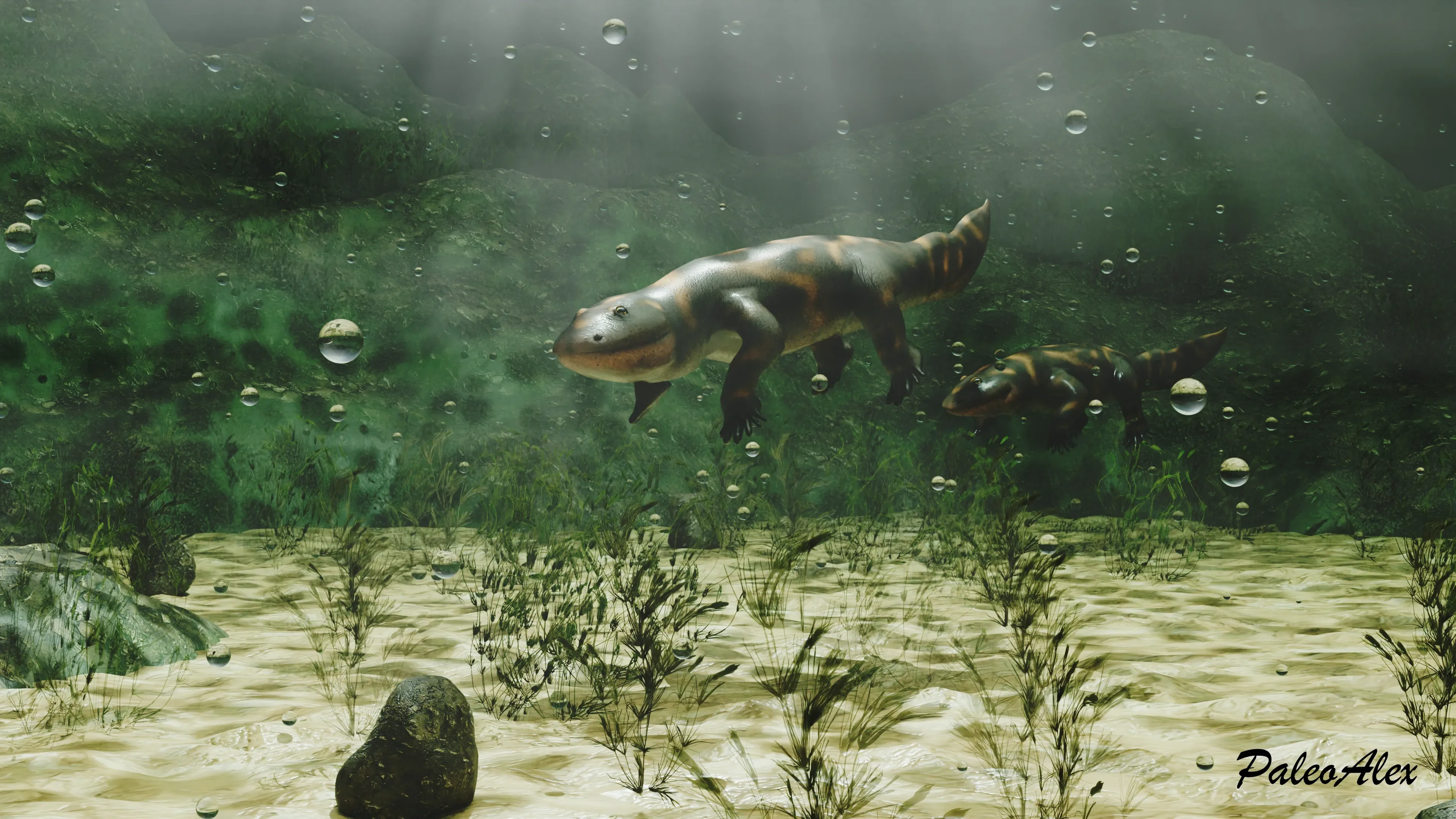
The Ichtyostega is an extinct genus of limbed tetrapodomorph, belonging to the "stegocephali", that lived in late Devonian about 365-360 million years ago in what Is now Greenland.
Ichtyostega was a giant animal for his time, measuring more than 1.5 meters in length and possessing a low skull with dorsally placed eyes and labyrinthodont teeth and across his snout and cheeks he possessed a lateral line system that allowed him to detect vibrations in the water.
His vertebral column was very rigid and had massive overlapping ribs to protect his internal organs and prevent his lungs from collapsing under his own weight when the animal went on land.
Instead of fins this animal possessed 4 limbs with 7 fingers on the hindfeet instead of 5, while the number of fingers on the forefeet is unknown.
He also retained a fish like tail fin, sign that this tetrapod spent a significant portion of his time swimming, but instead of heavy body scales its body was protected by small bony scales.
This animal represent of the earliest tetrapods, and due to his Hybrid anatomy he at as an evolutionary bridge between fishes and land-dwelling animals.
He was not an amphibian but his Hybrid anatomy that combined fish-like traits with land tetrapods traits, and he had a "unique locomotion".
For decades scientists tought this animal walked like modern salamanders but recent studies show that his rigid spine only moved comfortably up and down so on land he would have dragged his body using his forelimbs as crutches like modern Seals or mudskippers.
Even tough he wasn't an amphibian this animal marked a very special turning point in tetrapods' evolution.