Paleoart
Paleo art is a branch of natural science that is focused on an artistic but accurate depiction of prehistoric
Life.
This peculiar term was introduced in 1986 by Mark Hallet.
The reason why this art is so unique is the fact that its produced from the collaboration between scientists
and artists, to maximise the accuracy of the artwork, even tough since the more time pass the more we
know about prehistoric life, a lot of today accurate paleoarts will be outdated in the future.
Paleo art founding fathers
Mary Anning and Henry De la Beche
An important milestone in paleoart was Duria Antiquior, created in 1830 by English geologist Henry De la Beche.
Inspired by fossil discoveries made by Mary Anning along the Dorset coast, De la Beche produced a detailed scene depicting prehistoric marine life, including ichthyosaurs, plesiosaurs and other extinct organisms.
The artwork was notable because it attempted to reconstruct an entire prehistoric ecosystem rather than simply illustrating individual fossils.
De la Beche sold prints of the watercolor to raise money for Anning, who faced financial difficulties, making Duria Antiquior not only an important work in the history of paleoart but also an early example of paleoart being used to communicate scientific discoveries to the public.
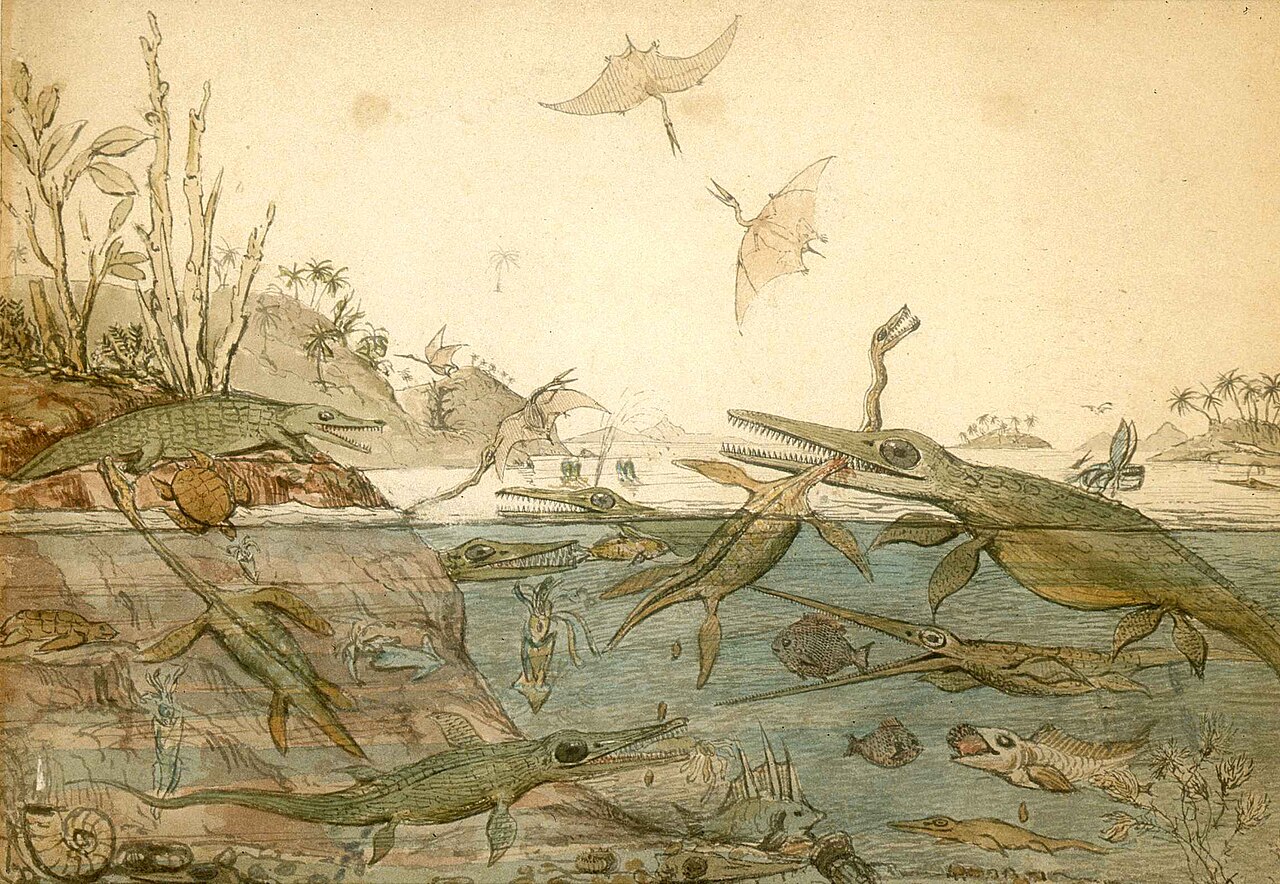
DURIA ANTIQUIOR
Sir Richard Owen
Sir Richard Owen was one of the most influential figures in the early history of dinosaur reconstruction.
As a leading British anatomist and paleontologist, he studied numerous fossil specimens and played a key role in establishing the scientific concept of the Dinosauria in 1842.
Owen believed dinosaurs were large, powerful animals with a distinctive anatomical structure, and his ideas strongly influenced how they were represented in early paleoart.
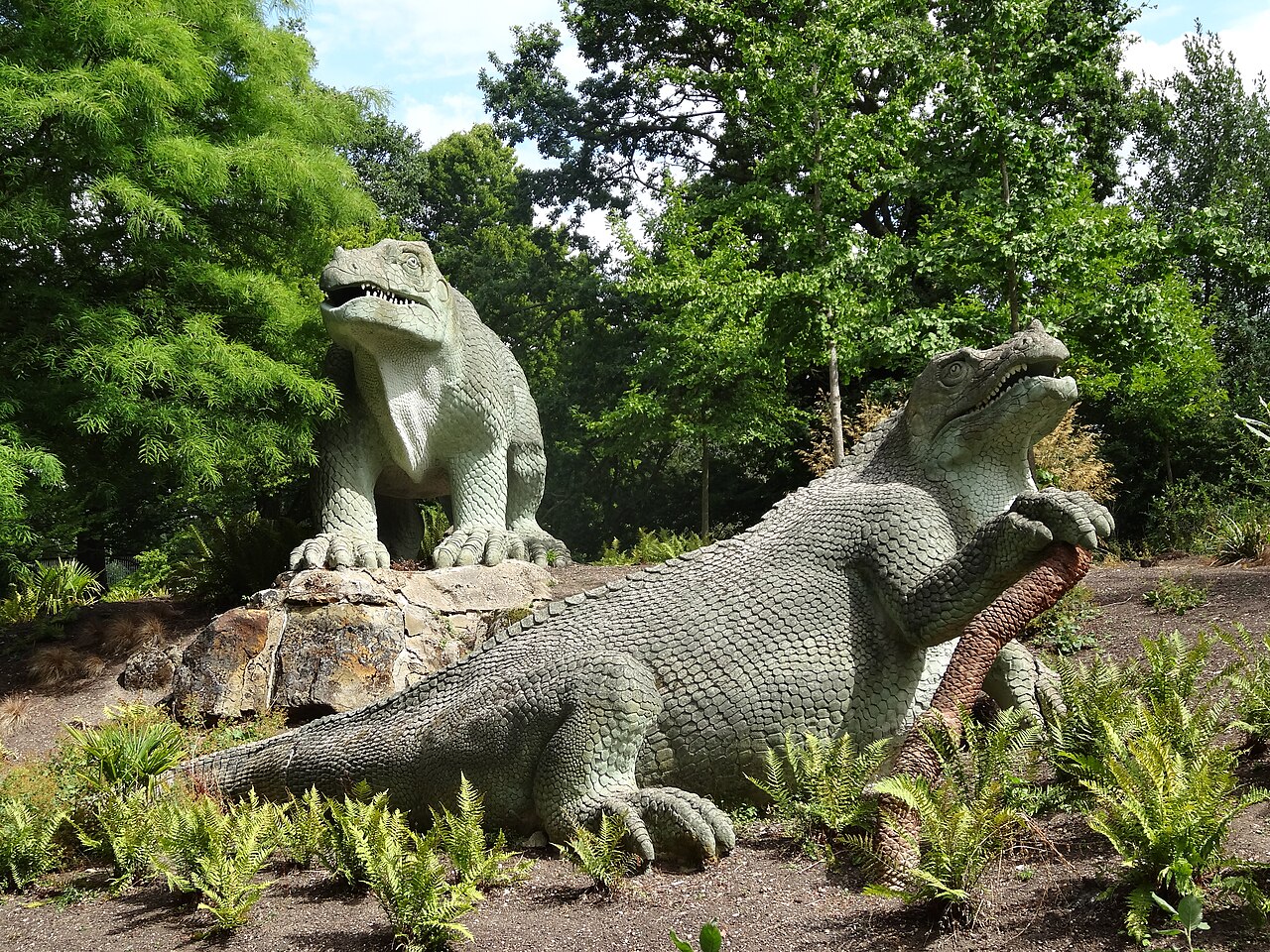
His collaboration with artist Benjamin Waterhouse Hawkins also led to the famous life-sized prehistoric animal sculptures at the Crystal Palace, helping bring dinosaurs and other extinct creatures into the public imagination.
Sir Richard Owen most famous work is the depiction of Iguanodon as an elephant-like lizard with an horn on the nose;
today we would consider this depiction outdated but at the time it was very accurate and reflected the limited anatomical and paleontological knowledge of that period.
IGUANODON
at Crystal Palace
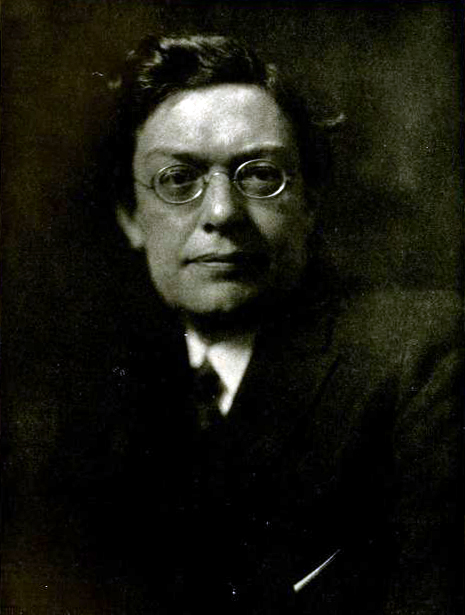
Charles R. Knight
Charles R. Knight (1874–1953) is widely regarded as one of the most influential paleoartists of the early 20th century.
Unlike many earlier reconstructions, Knight’s work attempted to portray prehistoric animals as living creatures, combining anatomical observation with a strong understanding of movement, behavior and natural environments.
Although he was not a paleontologist, he worked closely with scientists and studied fossil specimens, skeletal reconstructions and modern animals to produce more scientifically informed representations of extinct life.
Knight became particularly famous for his paintings and illustrations of dinosaurs and Ice Age mammals. His reconstructions often showed animals interacting with one another and with their surroundings, creating complete prehistoric scenes rather than isolated scientific illustrations.
Works depicting animals such as Tyrannosaurus, Triceratops, Brontosaurus, mammoths and saber-toothed cats helped establish many of the visual conventions associated with prehistoric life during the first half of the 20th century.
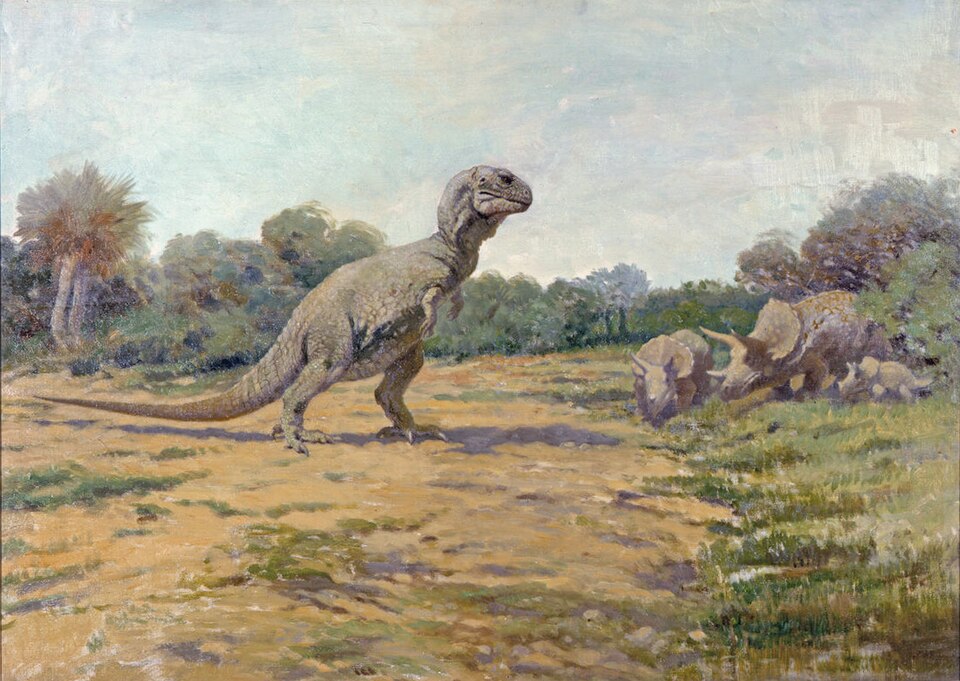
CHARLES KNIGHT T-REX
A major part of Knight’s influence came from his work for museums, including the American Museum of Natural History in New York.
His murals and illustrations allowed museum visitors to visualize animals that could otherwise only be understood through fossils and skeletal remains.
His paintings therefore helped bridge the gap between scientific research and popular culture, making prehistoric life accessible to a much wider audience.
Knight also represented an important change in the philosophy of paleoart. Earlier artists had sometimes reconstructed extinct animals according to assumptions that were later shown to be incorrect. Knight instead tried to base his work on the anatomical evidence available to him while using living animals as references for posture, musculature and movement.
His animals were therefore often depicted in dynamic poses and realistic environments, giving viewers the impression of observing a living prehistoric ecosystem.
However, Knight’s work was inevitably influenced by the scientific knowledge of his time. Some of his reconstructions, particularly those involving dinosaur posture, behavior and appearance, have since been revised as new fossil evidence has emerged. This does not diminish his historical importance; rather, his career illustrates how paleoart evolves alongside paleontology.
Through his combination of scientific observation, artistic skill and dramatic composition, Charles R. Knight helped establish a visual language for prehistoric life that influenced generations of artists, scientists, museums and filmmakers.
His paintings became some of the most recognizable representations of extinct animals of the 20th century and played a major role in shaping the public's image of the prehistoric world.